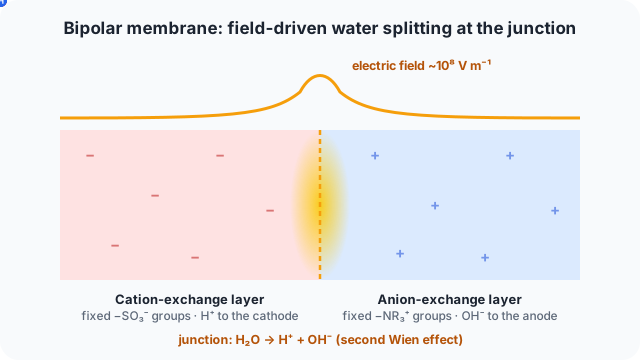
Bipolar membranes split water at the junction between a cation- and an anion-exchange layer, driven by strong local electric fields.
Approach
- Resolves the space-charge region at the junction, where fields of order 108 V m−1 accelerate water dissociation.
- Manuscript under review: “Water transport limitations in bipolar membranes for electrochemical CO2 reduction”, V. G. Agarwal and S. Haussener.
What I did
- One-dimensional Poisson–Nernst–Planck model with electric-field-enhanced (second Wien effect) water dissociation.
- Hydration-dependent transport and membrane water balance.
- Parametric and sensitivity studies to isolate rate-limiting transport mechanisms and guide membrane design.
Supervisor: Prof. Sophia Haussener.
Funded by the EPFLglobaLeaders programme, which received funding from the European Union’s Horizon 2020 research and innovation programme under the Marie Skłodowska-Curie grant agreement No 945363, and by the Swiss National Science Foundation (project 200021_197268).
From salt crossover to water-transport limitation
Model of a reverse-biased bipolar membrane in 1 M KHCO3 swept from 0 to 2 V: the polarization curve passes through four regimes (left), while the electric field at the cation|anion-exchange junction sharpens (top right) and the water inside the membrane is drawn down where it is split (bottom right).
Base case of the manuscript under review (αCL = 0.13), compared with the measurements of Bui et al. The field-enhancement factor is the model's increase of the water-dissociation rate at the junction.