← Research · PhD · 2021 – 2026
Bicarbonate-fed bipolar-membrane electrolysers
manuscript in preparation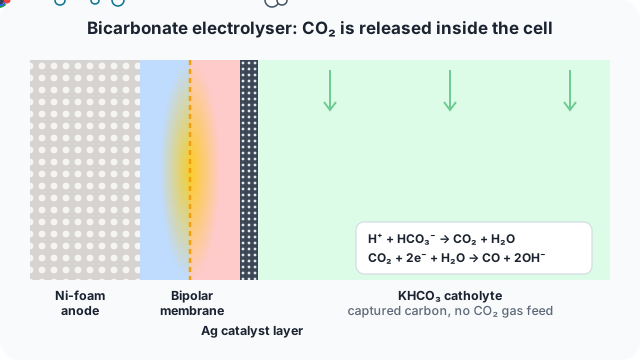
Bicarbonate electrolysers convert captured carbon directly, without regenerating and compressing CO2 gas: protons from a bipolar membrane release CO2 in the catalyst layer, where it is reduced to CO.
Approach
- Integrated model of a bicarbonate-fed electrolyser: Ni-foam anode, bipolar membrane, Ag catalyst layer and porous cathode.
- Tracks in-situ CO2 release from bicarbonate by membrane-generated protons and its reduction to CO.
- Results are in a manuscript in preparation.
What I did
- Coupled the gas-diffusion-electrode and bipolar-membrane models into one integrated electrolyser model linking electrochemistry, ion transport and water management.
- Validated against measured CO faradaic efficiencies.
- Used the model to evaluate catalyst-layer, substrate and membrane designs.
Supervisor: Prof. Sophia Haussener.
Funded by the EPFLglobaLeaders programme, which received funding from the European Union’s Horizon 2020 research and innovation programme under the Marie Skłodowska-Curie grant agreement No 945363, and by the Swiss National Science Foundation (project 200021_197268).